Script/Outline for Final Project
SCRIPT – The Future of Education
AI is rapidly changing and improving industries around the world, and the industry of education is no exception.
There is an incredible potential for AI technologies in the field of education. In this video, we will focus on AI and personalized learning in the classroom.
According to Bill Gates, “AI will improve education in many ways, but that providing more personalized learning for students will be the greatest benefit”.
Have you ever wondered why there are such high dropout rates in colleges and universities? Or why so many students in elementary and high school struggle to succeed? One of the main reasons for this is due to the ineffective traditional “one-size-fits-all” approach to learning.
Every student learns at a different pace, so teaching all students in the same way is not realistic in allowing them to reach their full potential.
That’s where personalized learning can help. This would motivate students and help them succeed as learning would be tailored to their own unique needs and abilities.
According to Office Ed Tech, “Personalized learning refers to instruction in which the pace of learning and the instructional approach are optimized for the needs of each learner.”
This can be achieved through AI-based learning systems. The AI could track students’ learning styles, abilities and progress. Then, it can suggest ways to customize the content so that the student understands it better. Also, Machine Learning algorithms can find patterns from data and help identify where students are having difficulty. This will enable teachers to have a better understanding of their students’ progress and enhance their success.
But you may be wondering: how would that even work?
2 words: DATA. ANALYTICS.
Data analytics is the idea of collecting personal student data that can then be used to help teachers locate problem areas and proactively find solutions to resolve them. In the future, experts believe that data analytics will be advanced enough to actually design personalized lesson plans.
But we’re not as far away from this as you may think! Let’s look at Content Technologies, Inc. (CTI).
This company is creating customized textbooks by leveraging Deep Learning. Have you ever wondered how textbooks’ material is chosen? Well, it’s tailored to the average student. However, as we’ve discussed, not all students learn in the same way and not all students are at the same level.
But the CTI system is able to read course content and find new patterns. Then, the algorithms use the found content to create new material and new textbooks based on the core concepts.
You may be wondering, what’s the flipside?
Well, some worry that it may not be equitable. Poorer schools may not have the same opportunities of including AI in the classroom compared to more wealthy ones.
Others worry about student data privacy. Collecting data is the foundation for AI, but this can be seen as an invasion of privacy.
Another huge concern is that educators will be entirely replaced in the classroom. While this is a valid fear, it really isn’t likely. According to the Harvard Business Review, “the best results will come from combining the strengths of AI and human abilities.” Human interaction and the human brain in the field of education will always be necessary. And a teacher’s role in guiding, mentoring and supporting students will never go obsolete.
There is definitely a long way to go before we can master AI in education, but its advantages are clear.
This is the Future of Education.
- I will narrate this script along with a Doodly video.
- It will be approx. 3 minutes long.
Artificial Intelligence & Learning Analytics
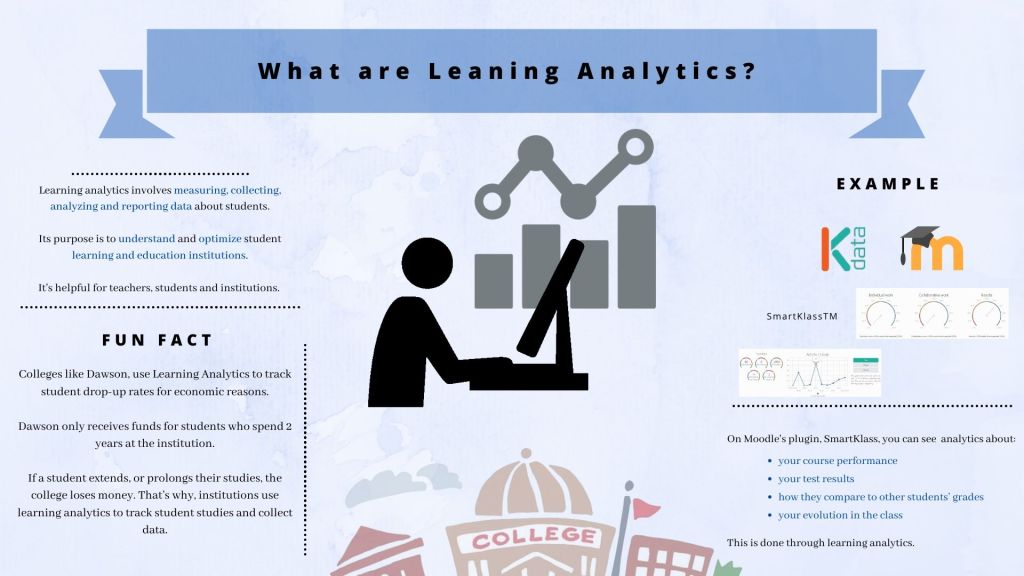
Learning analytics involves measuring, collecting, analyzing and reporting data about students.
Its purpose is to understand and optimize student learning and education institutions.
It’s helpful for teachers, students and institutions.
Here are some ways that teachers use learning analytics:
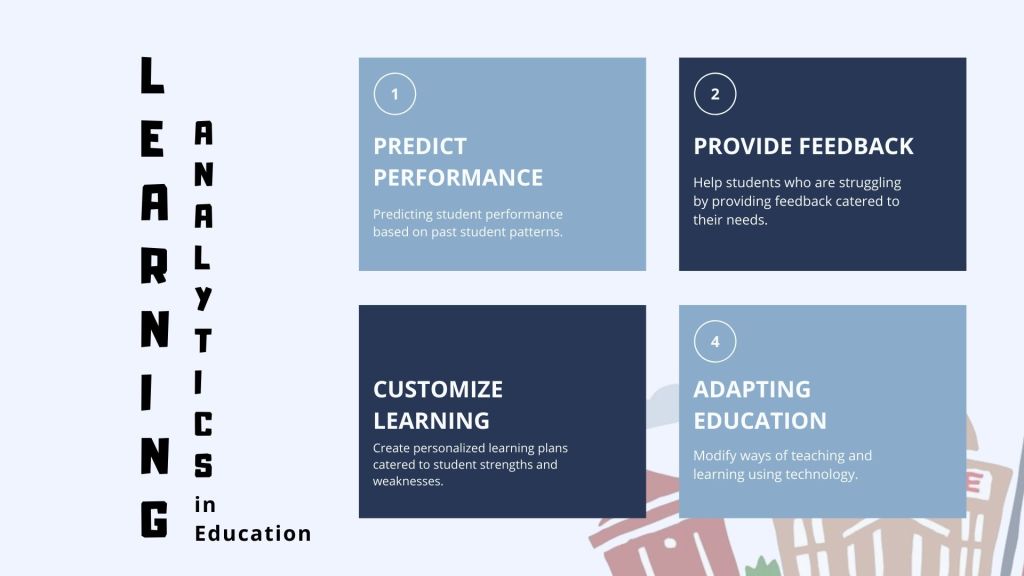
- Identity student patterns: helps the student receive more support and holistic assessment based on their individual need because the teacher is more informed
- Predict trends in student progress: determine how the student will perform in the future, and make a plan to properly support their needs
- Recommend resources and tools: the teacher can be offered tools that will help the individual student and cater to their needs.
- Track academically weak students: teachers get detailed information about each student so they can see who is struggling. By being able to compare all the students, it’s obvious which students need more attention. This prevents student drop-out or failures.
For example, teachers and colleges can use Moodle, and its plug-ins, such as SmartKlass™. These are two examples of Learning Analytic dashboards. Have you ever noticed when you go on Moodle, you can see various analytics about your course performance? You can see your test results, how they compare to other students’ grades, and your evolution in the class. This is done through learning analytics.
You may not know this, but colleges like Dawson, use Learning Analytics to track student drop-up rates for economic reasons. Dawson only receives funds for students who spend 2 years at the institution. If a student extends, or prolongs their studies, the college loses money. That’s why, they use learning analytics to track our studies and collect data.
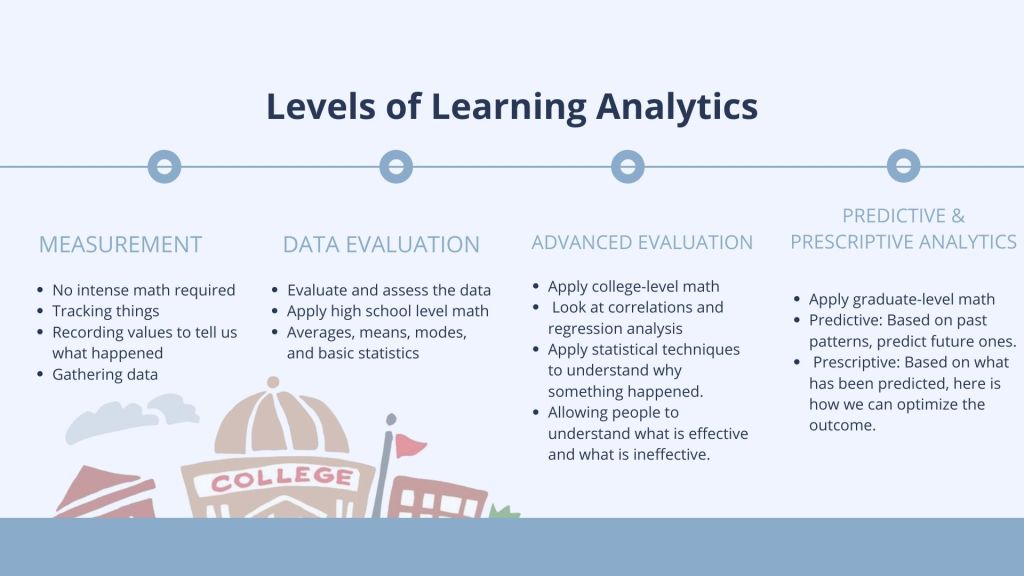
These are the levels of learning analytics:
1. Measurement
- No complex math required
- Tracking things
- Recording values
- Gathering data
2. Data Evaluation
- Evaluating and assess data
- Apply high-school level math : averages, means, modes, and basic statistics
- Do so to find all the data
3. Advanced Evaluation
- Apply college-level math
- Correlations and regression analysis
- Applying statistical techniques to know why something has happened
- Assess what is effective and what is ineffective
4. Predictive & Prescriptive Analytics
- Most sophisticated level of analytics
- Apply graduate-level math
- Predictive analytics: based on past patterns, predict future ones
- Prescriptive analytics: based on what has been predicted, here is how you can optimize the outcome
____________________________________________________________________
Browsing for an Interesting I.A post!
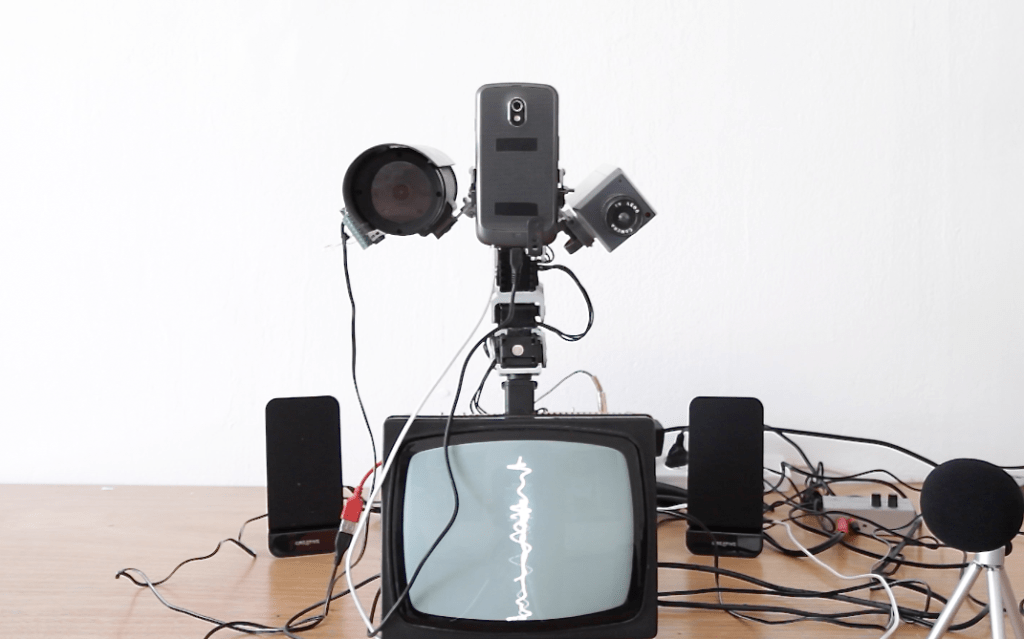
After browsing the website, I found The Frankie Project and it captured my attention more than anything else. This is a robot created by Maayan Sheleff, an independent art curator.

Frankie tries to answer the question: “what does it mean to be human?” He does so by interviewing individuals about their emotions. I think it is extremely interesting that a robot was created to answer that question as the real humans themselves don’t even know the answer. A philosophical question as such would be extraordinary if a robot could answer. In this interview, Frankie tries to learn about happiness and excitement. The robot asks questions like “what makes you excited” and “when was the last time you were really happy.” I think the robot does this to try and process these types of emotions to get a better understanding of them.
It is also so interesting how Frankie is built: the eyes are formed of cameras, the nose is a cell phone and the mouth is a TV screen.
 Media Lab AI
Brilliant and thorough. 20/20. Melissa, I’m wondering if I can team you up with someone else in the class to produce the whole class assignment. You have the personal work ethic. it will require you to focus on collaborative/interpersonal skills, which I sense you have as well.
LikeLike